

January 26, 2026. Good afternoon.
I haven’t been posting a lot because I’ve been working hard on my book proposal. But it’s hard to sit by while the Trump administration reduces this country to a dystopia few of us could have imagined even a few months ago.
Yesterday’s coverage of the death of yet another peaceful protester at the hand - or rather, gun - of an ICE agent in Minneapolis enraged me so much I had to write something.
BTW yes I know I keep veering very far away from the stated topic of this substack but I have rarely strayed from the themes. After reading so many partisan newspapers from the 19th century, I have sharpened my attention to how today’s media outlets (especially newspapers) cover the news.
So. Let’s start with the event. At about 9 A.M. Central Time on Saturday, Alexander Jeffrey Pretti was shot as he was filming ICE agents who had detained someone. As anti-ICE protesters gathered around the detainee, who at that point was on the ground, ICE pepper-sprayed them. Pretti seemed to try to help one of the protesters, when the ICE agents then turned on him. They wrestled him to the ground, then one shot him. Even after he lay motionless, one or more agent continued to shoot at him. He died at the scene.
I live a full sixty-eight miles from New York City, but that to me in no way explains why this was the front cover of yesterday’s NYT newspaper:
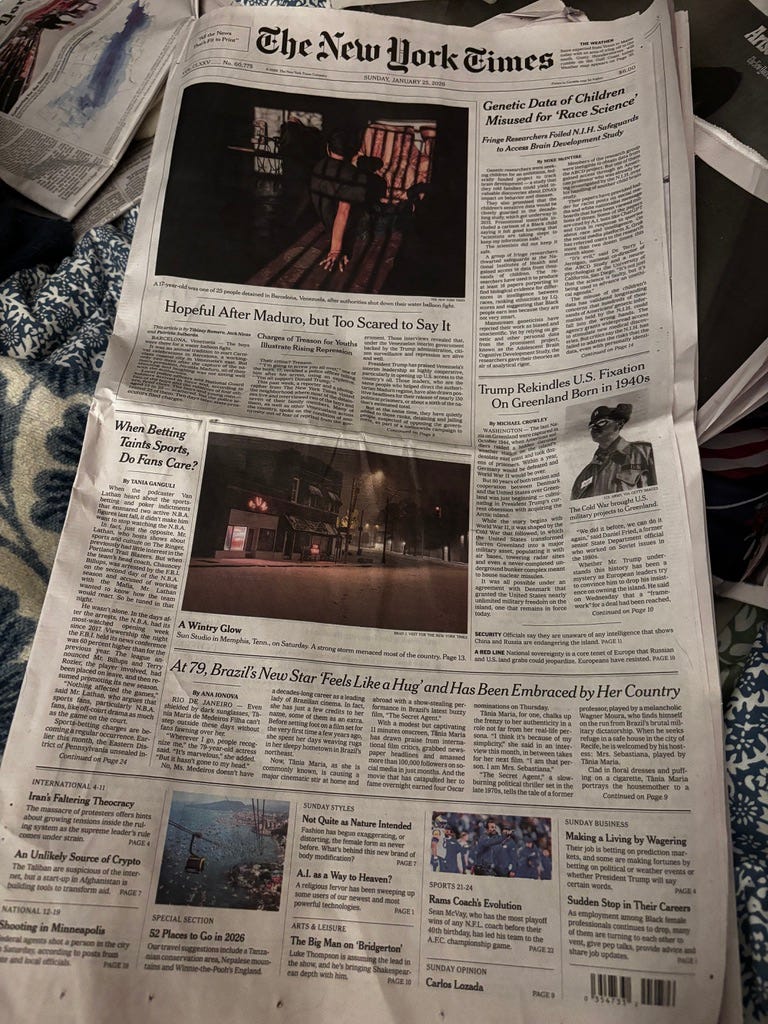
The killing of Mr. Pretti by an ICE agent is nowhere covered on the front page, except in one of the squibs at the bottom.
Not only that, but the story doesn’t show up until Page 18, four pages into the National section. The first article in the National section was about how Fayetteville, N.C. has found a way to “cut emissions and save money, too.” The entire second page covered various aspects of the impending snowstorm. The third page (titled “The 47th President”) is about how a Border Patrol officer’s pepper-spraying of an individual who had already been restrained was “provoking outrage.” Finally, way back on Page 18 (under, again, the headline “The 47th President”) there is an article titled “Federal Law Enforcement Agents Shoot a Person in Minneapolis.” The second paragraph states, “A post from the City of Minneapolis said that the officials had no immediate details….”
I am not suggesting that this was an editorial decision by the “paper of record” to bury a significant story. What I am insisting is that said paper do a better job of getting timely editions out. (It also didn’t include coverage of the storm until way inside the A section, where a good portion of that was devoted to the risk the storm posed to Mamdani’s mayoral honeymoon, naming the times New York City mayors had been laid low by their handling of a basic municipal priority.
I am one of a dwindling number of people who read the paper NYT, and I’m guessing that those of us who do get it, subscribe as much because we are news junkies and want to support the paper as much as we want to do the crossword on paper. We’re unlikely to mistake placement for priority.
And yet I was enraged! I checked my NYT app right after I found the piece to see how they were covering it online and was glad that this was the first story that popped up.
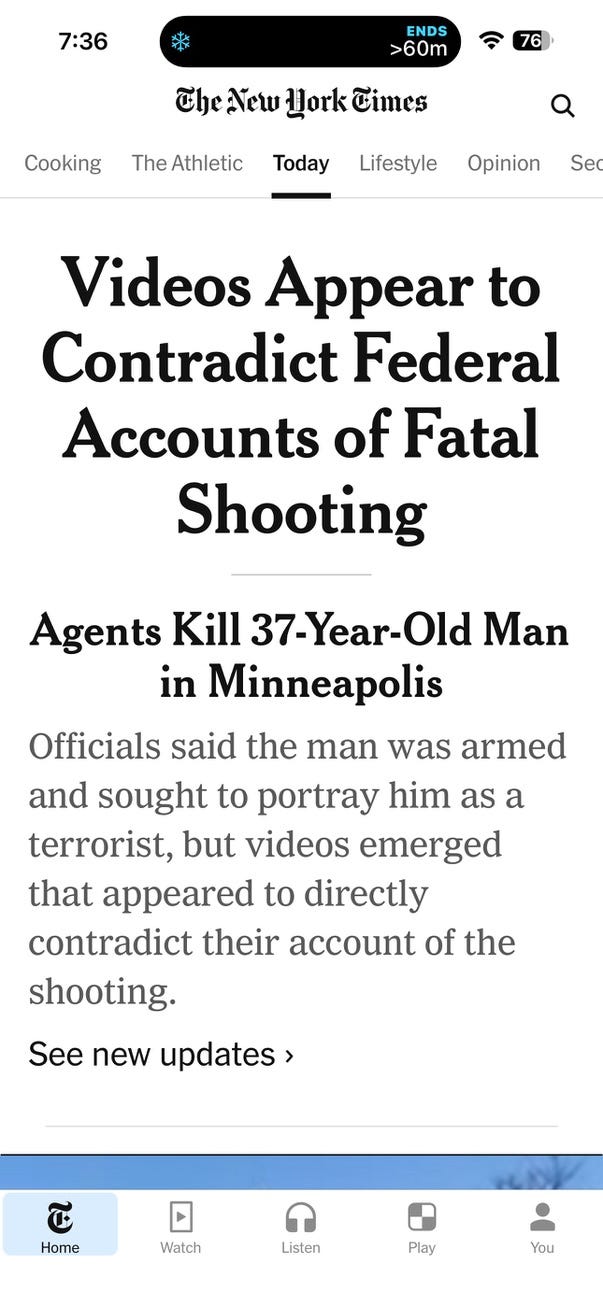
And yet: “appear to contradict”?? Seriously?
Out of curiosity, I checked the front pages of two other newspapers I read. Here they are:
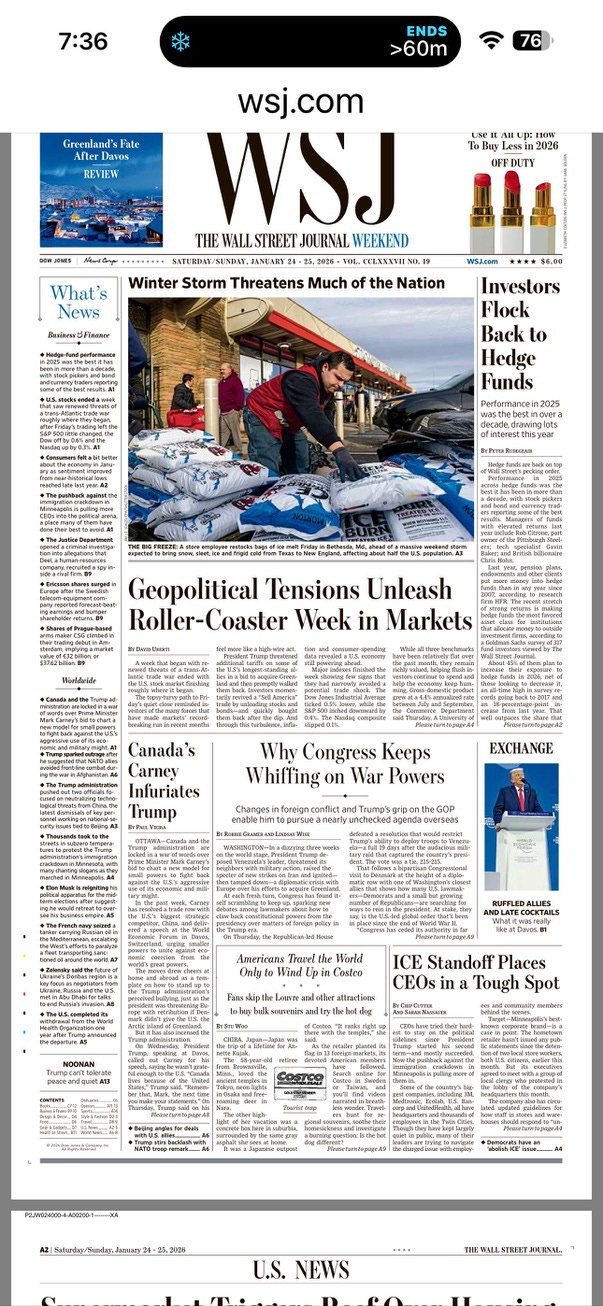
The winter storm shows up on the front page of the Wall Street Journal as it did not in the New York Times.
I do love that in the WSJ, the lone mention of ICE anywhere on the front page (including the squibs) is how hard the “standoff” is making it for CEOs. 😭
But here was the first story that popped up on their online edition:
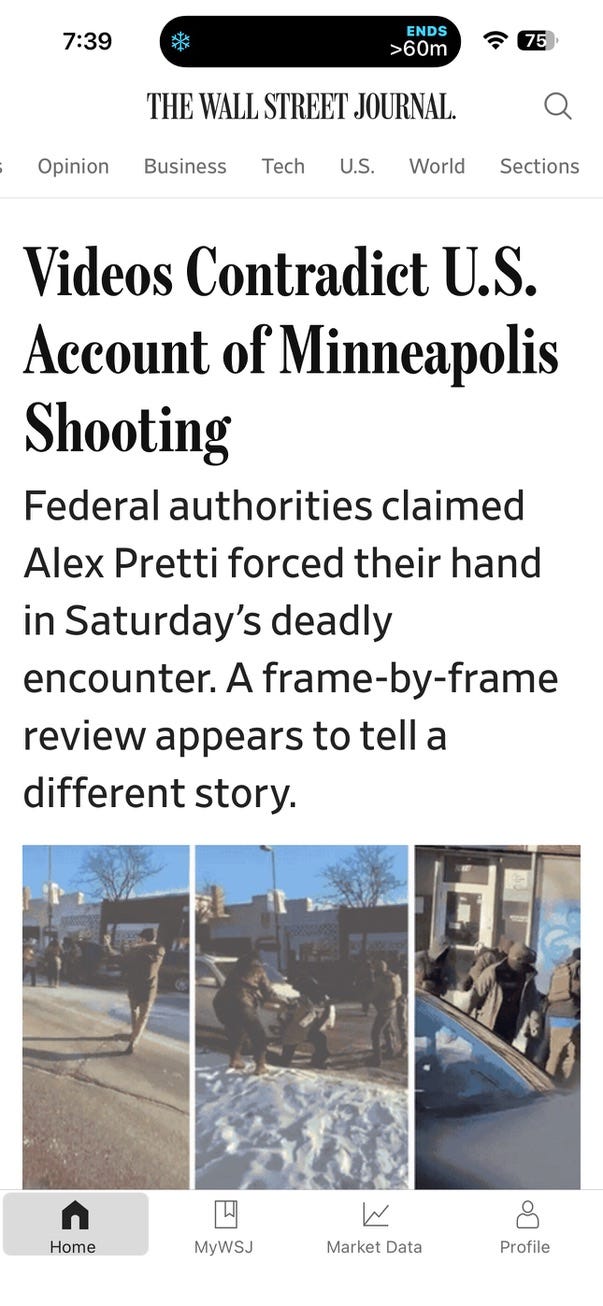
Good on the WSJ for using no qualifier whatsoever about what the videos of the killing of Alex Pretti showed. (Well, at least in the headline.)
Here’s the Washington Post front page:
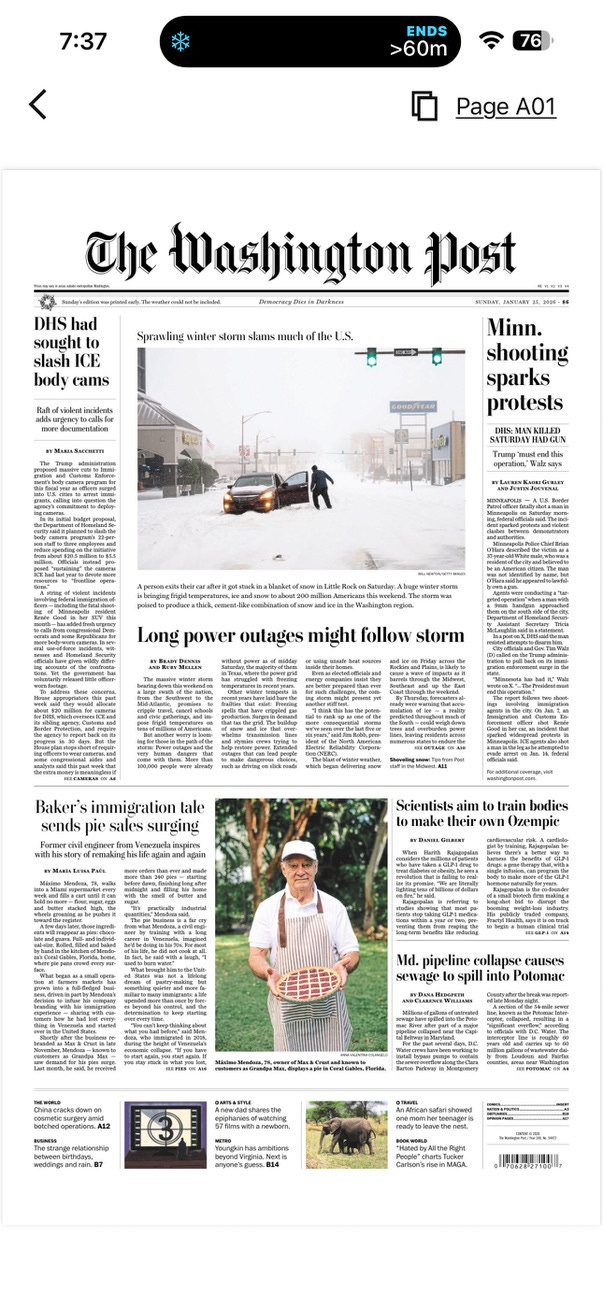
FINALLY: the story is on the right, above the fold. Also appropriately, they give good coverage of the snowstorm, which had a much greater chance of seriously impacting Washington, D.C., Maryland and Virginia, than New York City. Having grown up in D.C., I remember the joke that a heavy rain will shut down traffic in D.C., not to mention snow.
Here was the first story that showed up on their app:
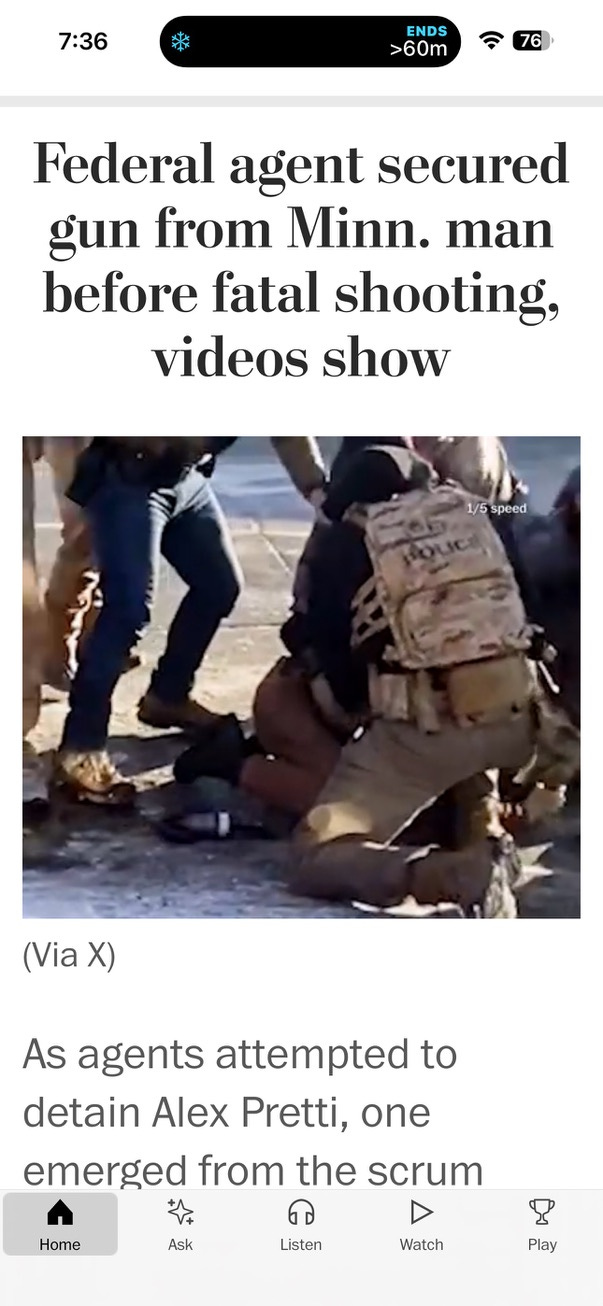
As you’ll see from the (inadvertent) time stamps, I checked all these within a few minutes of one another, so it’s fascinating to see how they differed in their coverage. The Washington Post was way ahead in the details they reported, and how quickly they reported on the significance of a second killing by an ICE agent in such a short period of time. Even the Wall Street Journal’s online stories seemed ahead of the New York Times in their review of the video footage, reporting what they saw when doing their own review.
The conclusion I come to is that the New York Times needs to overcome its caution in reporting what more and more seems to be a frontline in a war against authoritarian tactics in what is still a democracy. I can (sort of) understand why they feel a burden of responsibility as being seen as, indeed, “the paper of record.” And I understand that it’s important to get the facts nailed down, especially given the litigious and retributionist nature of this Administration. But I can understand that much more in a normal time. These are not normal times.
I was listening to a fascinating convo on Jon Stewart’s podcast “The Weekly Show” last week where he was speaking with Adam Tooze who writes the substack Chartbook and Ivan Krastev who is the Chairman at the Centre for Liberal Strategies in Sofia, Bulgaria and has just written “Is It Tomorrow, Yet?”
After bemoaning how Trump’s mere 12 months in office has brought this country so low in so many ways, Stewart wondered whether this country is doomed to become an autocracy, or whether we might already be there. It was Ivan, I think, who said (and I’m paraphrasing because I’m too lazy to find the transcript): “well, we can talk on this podcast, and share these views. That is not true in many parts of this world.”
Indeed.
We may fault the press for all kinds of things: it’s too partisan, it’s not partisan enough, much of it is corporate-owned, it doesn’t get its paper editions out on time. But it is, still, free. For now. This is the time for all media outlets to remember that they are a crucial component of a free democracy. That they are one of our last, best bulwarks against autocracy. They need to do what the reporter, first-generation Irish American Finley Peter Dunne put into the mouth of the fictional Mr. Dooley, in a Chicago newspaper a century and a quarter ago:
“The job of the newspaper is to comfort the afflicted and afflict the comfortable.”
As much as I believe the essence of that quote, historical accuracy requires me to report that this has been a misquote for years, that the original quote was much more critical of newspapers. Here it is, with apologies for the Irish vernacular that Dunne put into Dooley’s words:
“Th’ newspaper does ivrything f’r us. It runs th’ polis foorce an’ th’ banks, commands th’ milishy, controls th’ ligislachure, baptizes th’ young, marries th’ foolish, comforts th’ afflicted, afflicts th’ comfortable, buries th’ dead an’ roasts thim aftherward.”
Yes: It’s complicated. Good newsgathering is essential to a healthy democracy. Newsgathering in this country needs to be better than good, especially now.
I will hopefully be back sooner than later. I’m not writing this book because I think the world is in dire need of yet another niche history book, but I’m writing it because there’s a great story in there and I want to find out how it turns out! Which is as good a reason, I think, as any to write one. If people get an insight or two, as well as be entertained, all the better.
Once I get the proposal out, I’ll have more time for the Substack, which I truly love working on. (Unlike book proposals, which I do not love working on.)
Cheers,
Jen
Add more halos around your had for quoting Finely Peter Dunne. Bests Jon Randal
This is a very insightful essay Jen. From the beginning of time, humans wanted to share and communicate with others. From cave drawings to the Guttenberg bible and to the present, there is no question in my mind that we crave connections with each other. (Maybe with the exception of religious doctrines of silence).
The question today, with all the tools provided for communications, the one thing that remains constant is the human required to deliver the message. And therein lies the opinions, political influences, the greed for power and reputation. To me it is like kids in the school yard trying to outshout each other. Headlines, schmedlines--just get the attention of the reader , listener or viewer. Being careful of content appears not to be the objective.
Thank you.