
Don't Mess with Chicago
Trump is only the latest to have tried to tame the Windy City.

Thursday, October 9. Good evening.
I started to write this back when Trump threatened to come into Chicago with the National Guard, and then backed off. My uninformed opinion as to why he backed off the first time was that Trump is overly enamored of people who hold power, or at least people who look like they do. J.B. Pritzker just looks like the kind of Chicago guy you don’t want to mess with. The rationale for not going in - that it would be difficult to do legally - is not a reasoning Trump ever uses, so I like my idea better. And indeed the Feds are now on the brink of moving in on Chicago. [ed note: I finished writing this Thursday afternoon before a judge put the kibosh on the Feds.]
Trump initially made the threat because, well, it was Chicago. Preying on Chicago’s reputation as a violent city barely constrained by law, he called Chicago a “disaster” and a “killing field.”
He also said:
“We go in, we will solve Chicago within one week, maybe less.”
On Wednesday, Trump “mused” that Pritzker and Chicago Mayor Brandon Johnson should be put in jail for failing to protect ICE agents. Pritzker channeled many a previous Chicago politician when he retorted:
“If you come for my people, you come through me. So come and get me.”
Trump is by no means the first to believe he could “solve” Chicago, quickly or otherwise. Let’s take a look.
WAY Before the ‘68 DNC, or even Al Capone.
While most people envision tear gas and police, or tommy guns, fedoras, and Edward G. Robinson when reaching for a cliche about Chicago’s reputation for lawlessness and violence, it goes way back before then.
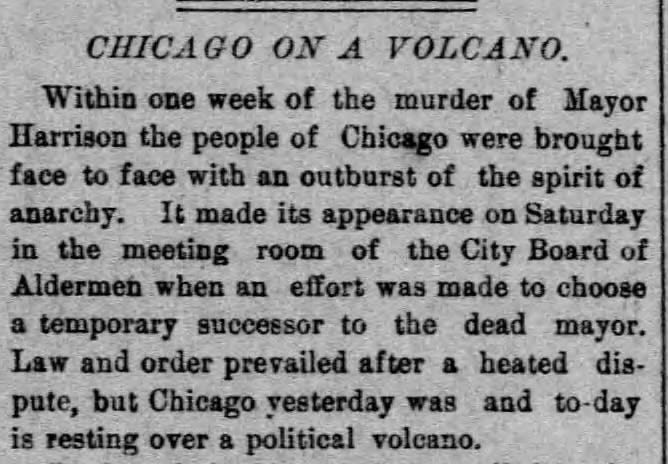
For example, in 1893, when, as regular readers of this substack know, Mayor Carter Harrison was gunned down by a disgruntled - and insane - campaign volunteer, and it was discovered there was no succession plan to replace a mayor who died while in office, national papers took notice. “Chicago on a Volcano!” screamed the Delaware Morning News. (Okay, not screamed exactly.) Even as the political crisis was resolved democratically - more or less - the country all but anticipated that the city might still descend into chaos. Why wouldn’t it? It was Chicago.
Back to the Beginning.
According to an article on Chicago and crime in the Encyclopedia of Chicago, Chicago’s reputation for lawlessness dates back very soon after it was incorporated in 1837. It was essentially a frontier town, with the Northwest Territory to its north and the Missouri territory to its west. (Let’s put aside St. Louis for a moment, which was founded years earlier. The whys and wherefores of how and why Chicago quickly overtook St. Louis in all way s is another story.)
According to the Encyclopedia:
By the end of the 1840s, observers both within the city and beyond regularly noted the existence of an identifiable criminal underworld. In the words of the [Chicago] Democrat, it was “getting to be a notorious fact that robbers, pickpockets, thimble riggers [literally, those who played the three-shell game, but more broadly any who used sly tricks to cheat], &c., &c., are perfectly at home in our city.”
Within 15 years of its founding, in other words, Chicago had already developed a reputation for lawlessness and violence.
Soon after that that Chicago began the first of many efforts to clean up its image. I love this 1857 editorial in the Chicago Tribune on the topic. (Of course, they couldn’t write about Chicago without taking potshots at its rivals.)
New York, San Francisco, and Chicago have heretofore had the reputation of being the worst-governed cities in the Union. In the first, official scoundrelism still runs riot; in the second a Vigilance Committee with a strong arm and inexorable purpose broke up the gangs of villains who virtually destroyed the elective franchise, defeated justice and protected crime; in Chicago, more peacefully, but quite as effectually, the work of reform is going on. An Irish Alderman in prison for rioting on election day, two Irish Justices of the Peace and three Irish constables, sentenced to Bridewell, and mulct in heavy fines for gross abuse of their official trusts, warrant the belief that the public, long outraged by crimes heretofore unpunished, is at last aroused by the duty of self-protection, and demands that the law shall be enforced. We congratulate our city readers [sic?] on the fact that the revolution in Chicago, so long needed and so long deferred, is about to be accomplished, and that the double-dyed villains who have abused authority, perverted justice and defied all law, are about to be scourged by appointed means, and without the intervention of the violence that our contemporaries of San Francisco were obliged to invoke."
The (Republican, and anti-Catholic) Tribune attributed the uptick in violence and crime in the city to “the Border Ruffian party,” which was a term Republican newspapers used in the 1850s for the Democratic party. The Border Ruffians were a group of pro-slavery raiders from Missouri who were fighting in the mid-50s to make sure Kansas became a slave state. Among their tactics were ballot and ballot box tampering, intimidation, assault, property damage, and murder. You might call them domestic terrorists today.
It’s interesting - perhaps even more so in our own moment - that the crimes the Trib took issue with were not crimes that affected the average citizen - thefts, street violence - but crimes that threatened municipal institutions. The Trib rightly surmised that if these institutions were undermined, the municipality had no hope for growth or success.
Would that this “long-deferred…revolution” had held. But it did not. How could it? Chicago has regularly cycled through attempts to either to burnish or banish this reputation. (I could do a whole Substack on the rhetorical contortions that some 19th-century newspapers went through to support gambling and beer halls, basically with the same rationale that has been used to decriminalize pot. )
It turns out that Chicago had a reputation for many things, some good, some not so good.
• Chicago wheat. (Not in a good way.) Sample critique:
“Our market for the last fortnight has disappointed everyone. Buyers of wheat having paid from 70 to 73 cts in the street, and much of it of a quality that will not add to the reputation of “Chicago wheat,” which has for some time been bad enough in our market…” — Buffalo Courier, September 9, 1843.
It wasn’t really the wheat, but the wheat inspectors in Chicago who were lacking in quality. They were overly lax in checking the shipments for quality and variety. I should note that these complaints were often if not usually printed in papers (such as the Buffalo Courier) whose cities had with competing grain ports.
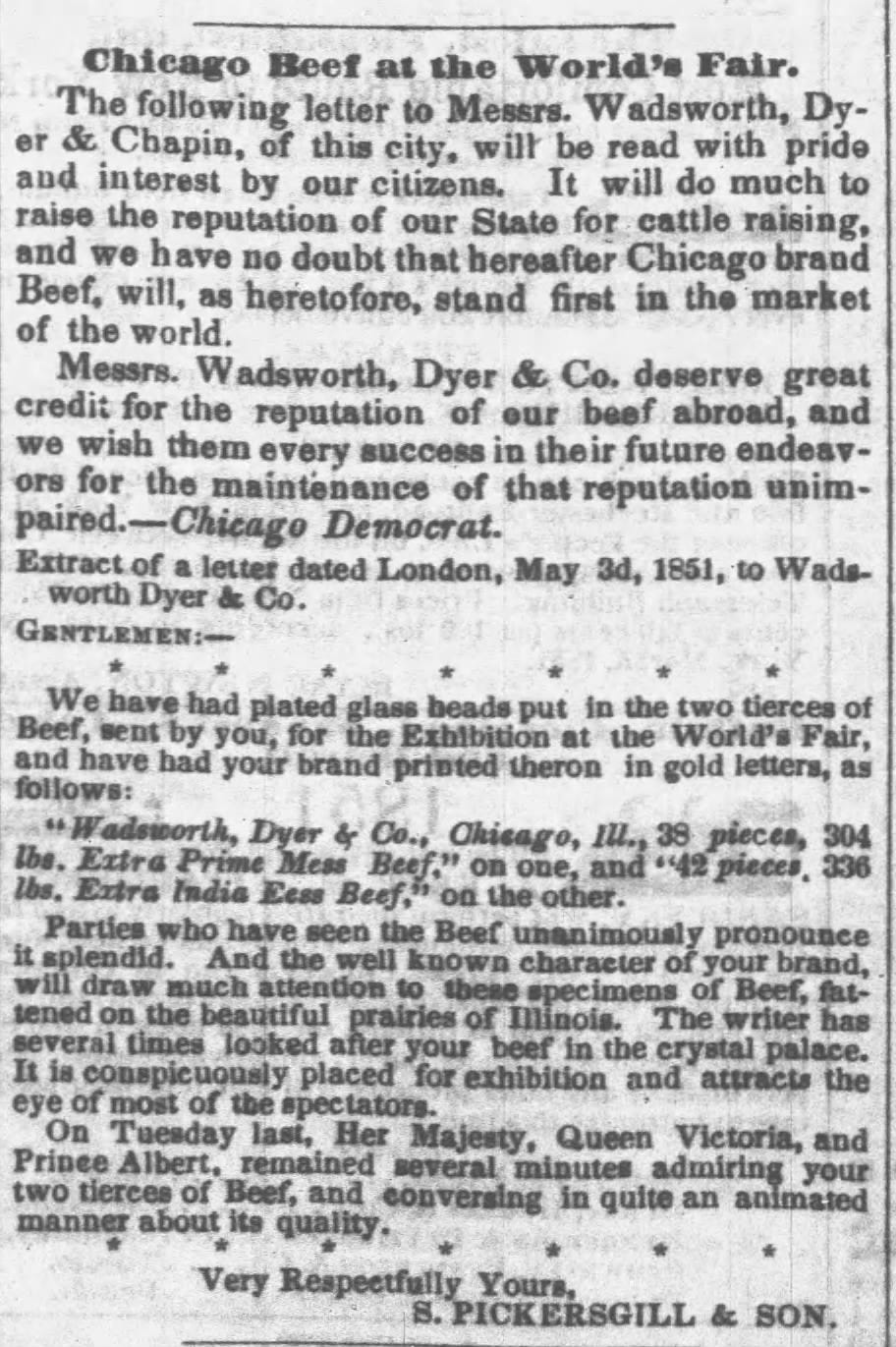
• Chicago beef “the best drove of cattle in the world.” Obviously. As anyone who relishes a good steak knows, this is a reputation that holds up today. What was striking to me is that as early as 1848, the high quality was attributed to the fact that they were “grass-fed.” (In case you thought that was strictly a 21st-century thing.) Chicago beef was so famous that, when samples were displayed at the 1851 World’s Fair in Buffalo, NY, it was viewed by no less than Queen Victoria and Prince Albert.
• Unruly citizens. In 1855, when attendees tried to shout down U.S. Senator (and future Lincoln debater) Stephen Douglas at a meeting in Chicago, the Weekly Indiana State Sentinel compared their behavior unfavorably to that of Chicagoans who had rioted that same year over an increase in the cost of liquor licenses from $50 to $300 a year and the closing of taverns on Sundays. (The henceforth known “Lager Beer Riot” was, as the Chicago Times itself noted, not the first riot that had occurred in Chicago.)
Huffed the Sentinel:
“However disagreeable it may be, the city of Chicago must bear the stain with which she was polluted by the high-handed violence of her good citizens against the Douglas meetings, and wear it too, in bold relief, until the events of the future, or obliterating time, shall have washed it from existence.”
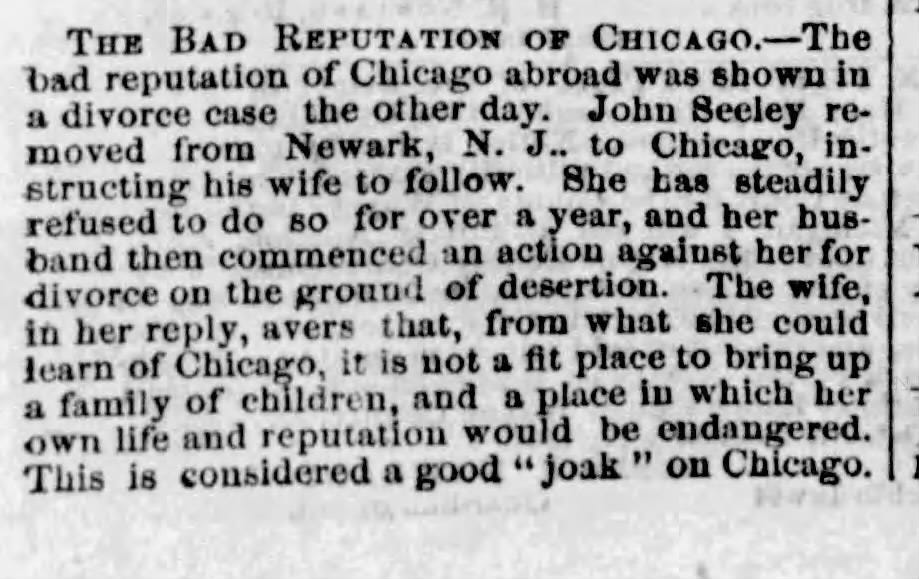
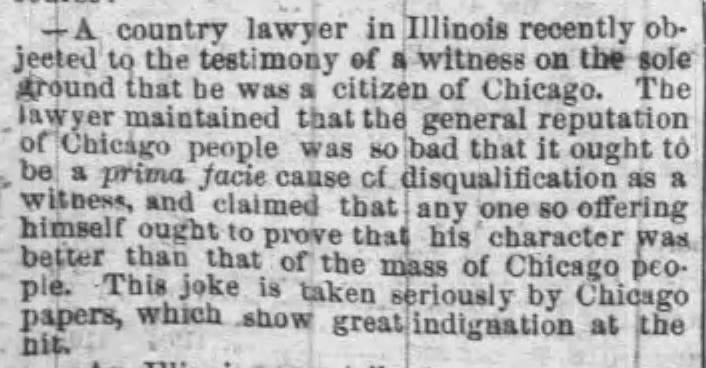
• quality of citizenry in general? This squib in the Detroit Free Press was reprinted across the country in 1867.
For whatever reason, other states were just dumping on Chicago in the 1860s. Perhaps because of Chicago’s arrogance? Which it was also known for.
Such was Chicago’s infamy by the 1870s that after the Fire of 1871 (obviously not known as the Great Chicago Fire in Chicago), the Encyclopedia of Chicago reports:
So wicked was the city’s reputation that many saw the Fire of 1871 as divine retribution against a modern-day Sodom and Gomorrah. Lawlessness after the conflagration gave no cause for optimism. “The city,” one newspaper reported, “is infested with a horde of thieves, burglars and cut-throats, bent on plunder, and who will not hesitate to burn, pillage and even murder.”
• Chicago newspapers. In 1888, an essayist named A.L. White wrote in Harpers New Monthly Magazine that Chicago journalism was “like the city itself - one of the wonders of the times.” Chicago was awash in newspaper reporting. Not only were there several dailies and weeklies for Republicans and Democrats, but socialists and anarchists had their own newspapers, as well as newspapers in German, Swedish, Polish, and others. In addition, White pointed to the distinctive tone of most of Chicago’s newspapers:
There is, it is true, running through a majority of the articles, an indescribable quality due to the influence of a community where, according to the local slang, “everything goes and goes like thunder,” a disposition to carry a point by the use of the bludgeon instead of the more artistic flourish of the rapier; but, like most Western writers, Chicago editors go to the point aimed at by very direct lines and when it is reached no reader has any difficulty in finding out what it is.
As tempting - and honestly more fun - as it is to veer back into the more salacious sides of Chicago’s reputation, I can’t end this article without noting that Chicago’s motto, adopted the year it was incorporated, is “Urbs in Horto.” This was back when people learned Latin. For the rest of us, that means “The City in a Garden,” a motto by which it’s still known, and deservedly so.
In the 19th century, newspapers inside and out of Chicago shortened that to “the garden city.” I must note, however, that the moniker was often employed to soften a critique. So for example:
“It is our unpleasant duty, as faithful chroniclers of passing events, to record the probable commission of another atrocious murder in our city. We would gladly save the reputation of Chicago by forbearing all mention of these murderous cases, the startling frequency of which has given the Garden City an unenviable reputation abroad. - Chicago Evening Post, December 4, 1866.
As an old citizen of Chicago I have been much pained to discover a wide-spread feeling of distrust in the morality of the Garden City. I noticed this while in Virginia recently, and also in Cincinnati and other parts of Ohio, but was perfectly astonished to hear the remarks that are being made in regard to the character of the city at different parts in the East. The people here seem to regard it as the chief hot-bed of crime in America. It has come to such a pass that if a low writer for the Police Gazette, or a still lower anecdote-mumbling tippler of a bar-room wants a location for a particularly dastardly yarn, he names Chicago. —F.D.C in a letter to the editor, Chicago Tribune, October 29, 1867.
And yes, these were written by Chicago’s reporters.
Time will tell how today’s Feds do in trying to bring Chicago to heel. I wouldn’t bet on it.
Thanks as ever for reading!
Jen
"The Trib rightly surmised that if these institutions were undermined, the municipality had no hope for growth or success."
Yet Chicago thrived, revived and it is a beloved city to visit by people all over the world.
May the U.S. profit by the knowledge that our imbedded institutions will survive all attacks against them. And my our contemporary media read Jen. Just's substack!!!!
They will learn a great deal.
Another great essay. I lived in Chicago for seven years. I was robbed on the street three times. I blame myself for being in what I knew was the wrong place at the wrong time. I still love Chicago and I brag about knowing what a tough place is like. Cheers for Pritzker.